How to Stop Buying Skincare You Don’t Need Without Losing Your Love for Beauty
There is a quiet moment that happens before almost every skincare purchase. You are scrolling, reading, comparing, imagining. The product promises refinement, balance, clarity, or transformation. It suggests that your current routine, though functional, could be better.
The modern beauty industry does not sell products as much as it sells possibility. A serum is never just hydration. It is luminosity. A moisturizer is not just barrier support. It is resilience, glow, correction. When framed this way, buying feels productive rather than indulgent. Purchasing feels like progress.
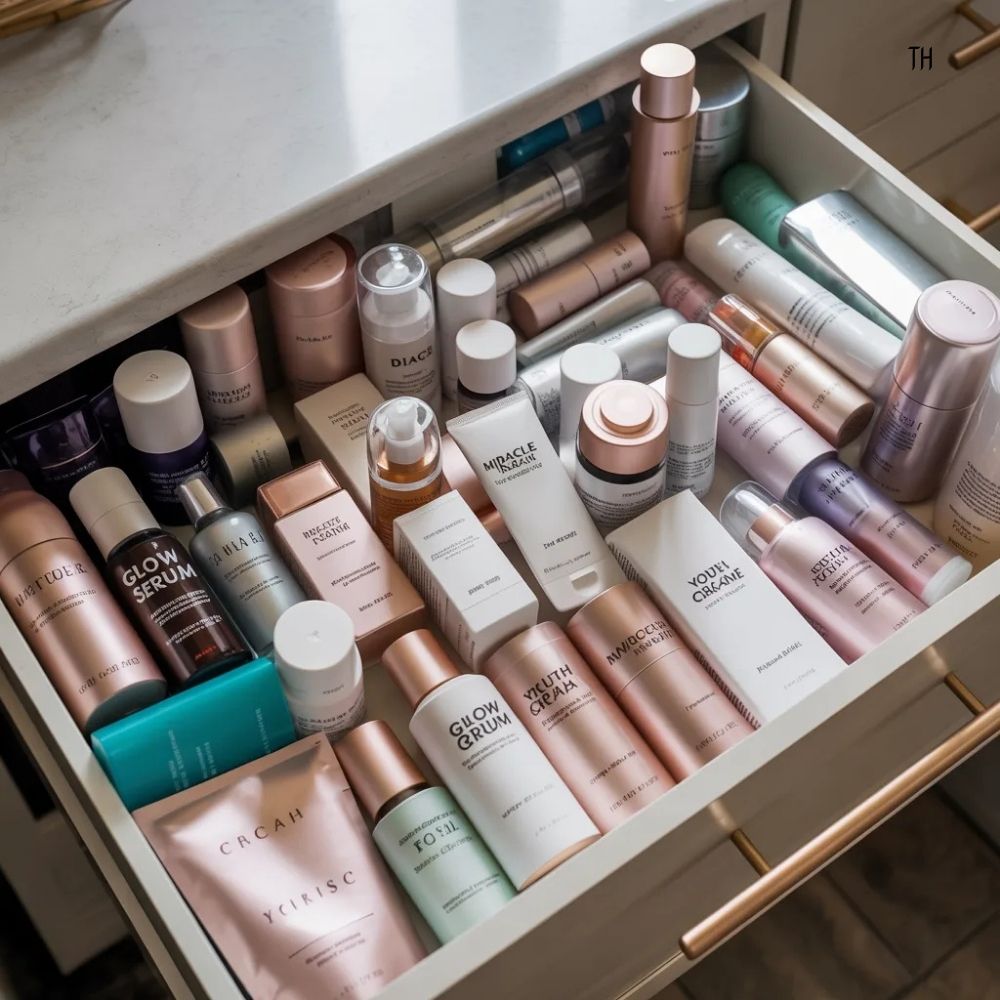
Yet many skincare collections tell a different story. Three exfoliants competing for the same role. Multiple vitamin C serums opened simultaneously. Retinoids layered over acids in pursuit of acceleration. Products purchased in excitement that now sit half-used, quietly aging in drawers.
Learning how to stop buying skincare you don’t need is not about rejecting beauty culture. It is about stepping outside its momentum long enough to evaluate what actually serves your skin, your budget, and your attention.
Why It Feels Hard to Stop Buying Skincare You Don’t Need
Skincare overconsumption is rarely rooted in irresponsibility. It is rooted in psychology. The first psychological driver is improvement bias.
Skin changes constantly. A breakout, a dull week, a hormonal shift, a dry patch. Because change is visible, it creates urgency. When we see fluctuation, we instinctively reach for intervention. The idea that the skin might self-correct feels passive. A new product feels proactive.
The second driver is exposure saturation. Algorithms ensure that once you show interest in a category, you see it repeatedly. A sunscreen appears in a review. Then in a tutorial. Then in a “must-have” roundup. Familiarity breeds trust. Trust lowers resistance.
The third driver is identity reinforcement. Skincare is not just maintenance; it has become self-care language. To participate in launches, to know ingredients, to refine routines, feels culturally fluent. Choosing not to purchase can feel like stepping outside the conversation.
When you understand these drivers, it becomes easier to stop buying skincare you don’t need without feeling like you are rejecting beauty altogether.
The Subtle Cost of Skincare Accumulation
Financial cost is obvious. Dozens of mid-range products purchased throughout the year quietly accumulate into substantial spending. However, the hidden cost is cognitive.
More products create more decisions. Which exfoliant tonight. Which serum this morning. Whether to combine or separate actives. Whether irritation is purging or damage. When routines become overly complex, clarity disappears.
There is also biological cost. Layering too many actives increases the risk of barrier compromise. Skin that is constantly stimulated rarely reaches stability. Instead of improving, it oscillates. When you stop buying skincare you don’t need, you reduce not only spending but also decision fatigue and barrier stress.
The Illusion of “Just in Case” Products
One of the most common rationalizations for impulse skincare buying is preparation. You buy a brightening serum in case hyperpigmentation worsens. You purchase a stronger acid in case texture increases. You add a calming cream in case sensitivity returns.
The problem with “just in case” purchasing is that it assumes instability as the default state. Skin does not require a contingency plan for every possible scenario. It requires consistency.
A stable routine built around gentle cleansing, barrier support, and sunscreen addresses most concerns preemptively. Excess contingency products create clutter rather than security.
Conducting a Strategic Skincare Audit
If your goal is to stop buying skincare you don’t need, begin with visibility. Lay out every product you own. Do not evaluate yet. Simply observe. Then group by function rather than brand:
Cleanser
Exfoliant
Antioxidant
Retinoid or treatment
Moisturizer
Sunscreen
Masks
Notice overlap. Two exfoliating toners. Three hydrating serums. Multiple moisturizers for identical seasons.
Ask yourself which products have produced measurable improvement and which were purchased because they sounded compelling. The audit is not an exercise in guilt. It is an exercise in awareness.
The One-Role Rule
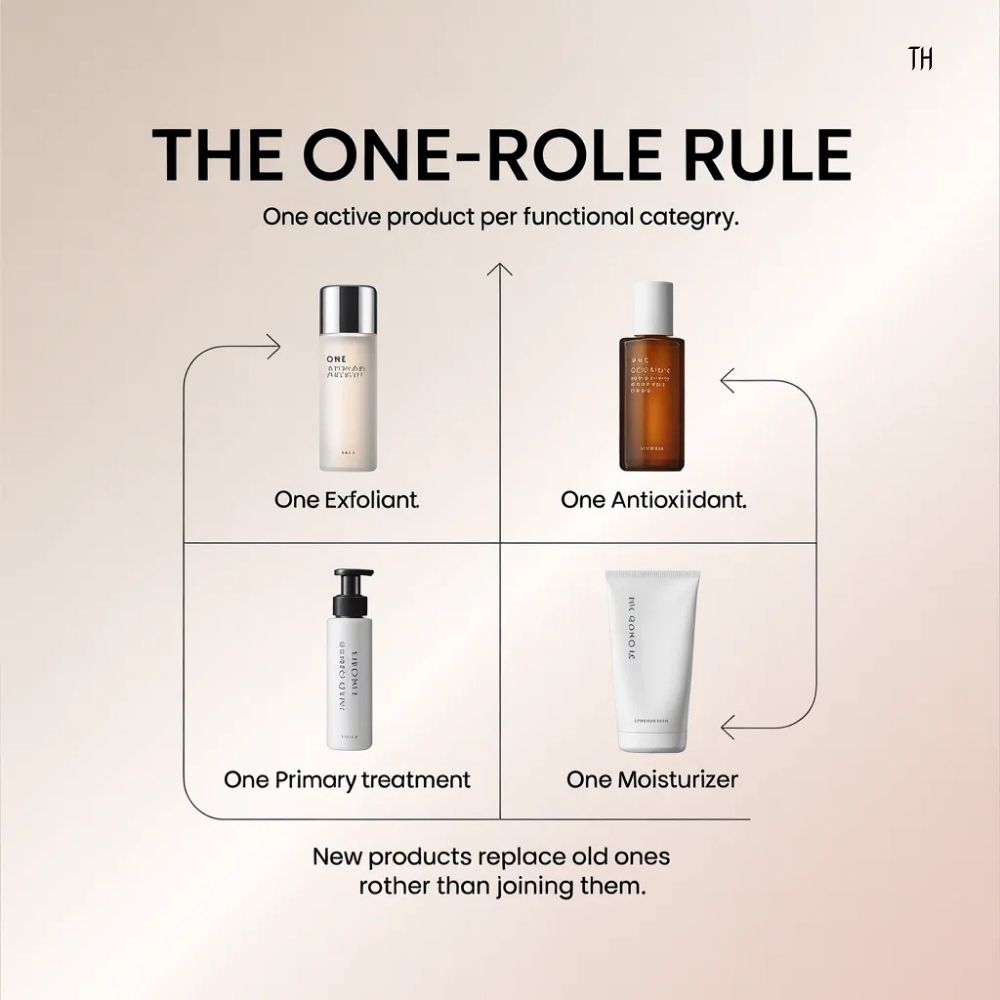
A practical framework for preventing skincare overconsumption is what I call the One-Role Rule. Each functional category in your routine should have one active product at a time. One exfoliant. One antioxidant. One primary treatment. One moisturizer per season.
This does not mean you never experiment. It means that new products replace old ones rather than joining them. The One-Role Rule eliminates redundancy, reduces confusion, and simplifies evaluation. When you know which product performs each role, results become easier to interpret.
The 30-Day Decision Filter
Impulse skincare buying thrives on immediacy. To counter it, introduce delay. When a product captures your attention, write its name down. Do not purchase immediately. Wait 30 days.
During those 30 days, observe your skin honestly. Does the concern the product claims to solve persist consistently, or was it situational. Does your current routine already address the issue adequately.
Often, urgency fades. When it does not, the purchase becomes deliberate rather than reactive. Deliberate buying strengthens long-term satisfaction.
Understanding the Marketing of “More”
The beauty industry often promotes layering. Add this booster. Follow with this mist. Seal with this oil. Each addition is positioned as enhancement rather than duplication.
However, skin does not always benefit from maximalism. The barrier thrives on balance. Marketing language frequently equates complexity with sophistication. In reality, elegance in skincare often looks like restraint.
Stopping unnecessary purchases requires recognizing when marketing is selling aspiration rather than necessity.
When Skincare Becomes Emotional Regulation
It is important to acknowledge that skincare buying can function as emotional comfort. After a stressful week, a new mask feels restorative. After disappointment, a serum feels hopeful.
There is nothing inherently wrong with this. Beauty can be ritualistic and soothing. The key difference lies in frequency and awareness.
If purchasing becomes the primary coping mechanism, accumulation follows. If indulgence remains occasional and intentional, it retains pleasure without excess. Stopping skincare overconsumption does not mean eliminating joy. It means choosing joy consciously.
Building a Minimalist Skincare Routine That Still Feels Luxurious
Minimal does not mean austere. A streamlined routine can still feel elevated. Morning may consist of a gentle cleanser, an antioxidant serum, a moisturizer suited to your climate, and sunscreen.
Evening may include cleanser, retinoid or treatment on alternating nights, and a nourishing cream.
This structure supports protection, repair, and hydration without overwhelming the barrier. Luxury comes from texture, from consistency, from knowing that each product has earned its place.
The Financial Reframe
Instead of calculating cost per product, consider cost per result. If you purchase three similar serums and use each inconsistently, the cost per effective result increases. If you commit to one well-formulated product and use it consistently until empty, the value improves.
Financial restraint in skincare does not mean buying the cheapest option. It means maximizing what you already own before expanding.
Redefining Progress
Perhaps the most powerful shift in learning how to stop buying skincare you don’t need is redefining what progress looks like. Progress is not constant novelty. It is stable improvement.
When your skin feels balanced, hydrated, and calm, you are not stagnating. You are maintaining. Maintenance is often the stage at which the skin looks its best. Chasing perpetual improvement can disrupt the very stability you worked to achieve.
The Confidence of Enough
There is a quiet sophistication in knowing when to stop. When you stop buying skincare you don’t need, your shelf becomes curated rather than crowded. Your routine becomes intentional rather than experimental. Your skin becomes stable rather than reactive.
You begin to understand that beautiful skin is less about accumulation and more about alignment.
Restraint, practiced consistently, becomes its own form of refinement. And in a culture that constantly encourages more, the decision to choose enough may be the most radical skincare habit of all.