The Daily Skincare Routine That Actually Works in 2026 Backed by Research
If you scroll long enough, you will find someone insisting that you need a twelve-step ritual, a rotating schedule of actives, three different exfoliating acids, and a refrigerator dedicated to serums.
A few swipes later, someone else will declare that you should throw everything away and rinse with water only. Between maximalism and minimalism, it becomes surprisingly difficult to answer one very basic question: what does a daily skincare routine that truly works actually look like?
The answer is less dramatic than the internet would have you believe, and far more stable. A daily skincare routine that works for most skin types does not rely on novelty. It rests on skin biology.
It supports the barrier. It protects against ultraviolet damage. It regulates inflammation. It introduces actives strategically rather than impulsively. When you strip away marketing cycles and aesthetic packaging, what remains is structure.
In 2026, the most effective daily skincare routine is not the most complex one. It is the one that aligns with how skin functions.
What Your Skin Actually Needs Every Day
Before building a daily skincare routine, it helps to understand what skin is doing continuously, whether you intervene or not. The skin barrier is composed of corneocytes held together by lipids, often described as a brick-and-mortar system.
This barrier prevents transepidermal water loss and protects against environmental aggressors. It regenerates approximately every 28 days in young adults, though that timeline slows with age.
Every day, your skin encounters ultraviolet radiation, pollution, temperature changes, friction, and hormonal fluctuations. In response, it produces sebum, triggers inflammatory signals when necessary, and attempts to maintain equilibrium.
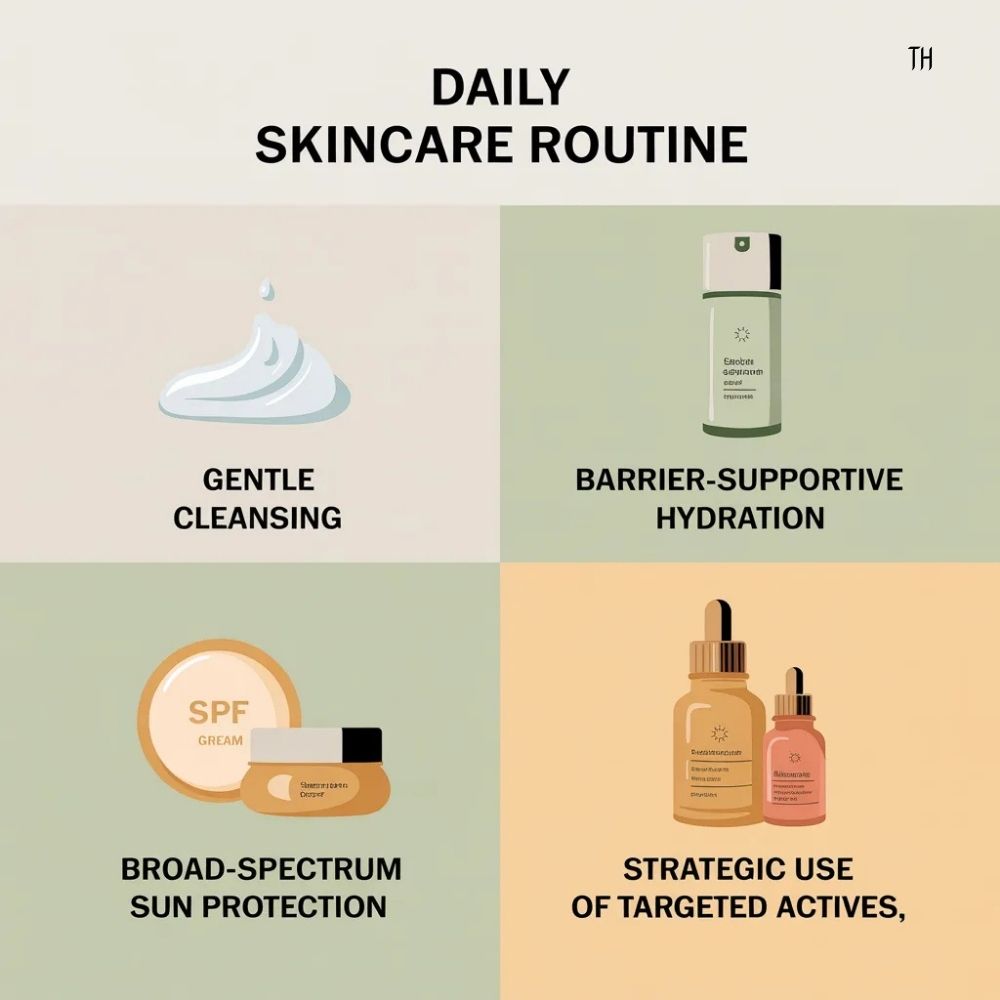
A daily skincare routine that works must support these processes rather than fight them. Research consistently supports four foundational pillars:
- Gentle cleansing
- Barrier-supportive hydration
- Broad-spectrum sun protection
- Strategic use of targeted actives
Everything else is optional or conditional.
The Morning Daily Skincare Routine That Works for Most Skin Types
Morning skincare is primarily about protection and preparation.
Step One: Gentle Cleanser or Water Rinse
Not every skin type requires a full cleanse in the morning. For dry or sensitive skin, rinsing with lukewarm water may be sufficient. For oily or acne-prone skin, a gentle low-pH cleanser helps remove overnight sebum and sweat.
Research shows that harsh surfactants can disrupt the lipid barrier, increasing irritation and sensitivity over time. Therefore, the goal is removal without stripping.
Look for sulfate-free formulas with mild cleansing agents. Cream or gel cleansers without heavy fragrance are generally well tolerated. The daily skincare routine begins with balance, not aggression.
Step Two: Antioxidant Serum (Optional but Evidence-Supported)
Vitamin C remains one of the most studied topical antioxidants. It supports collagen synthesis and neutralizes free radicals generated by UV exposure and pollution.
A research-backed daily skincare routine often includes a stabilized vitamin C serum in the morning, particularly for those concerned with hyperpigmentation or early signs of aging.
However, vitamin C is not mandatory for everyone. If your skin is reactive or prone to irritation, simplicity may serve you better. Consistency matters more than stacking actives.
Step Three: Moisturizer
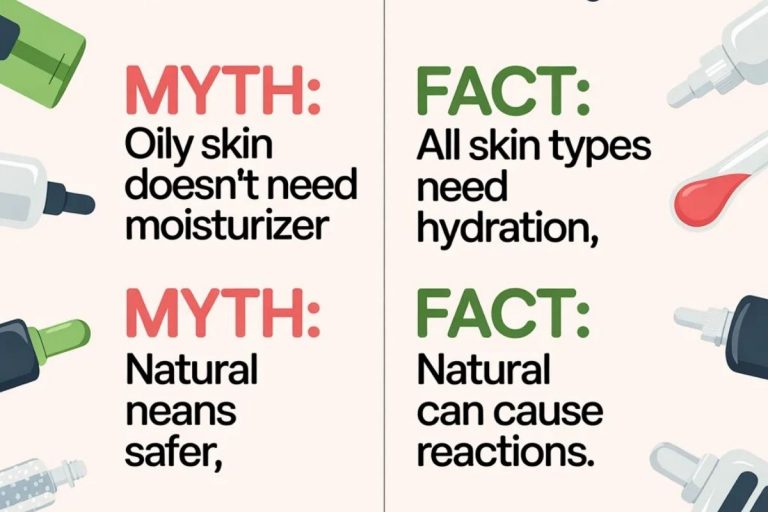
Hydration is non-negotiable in a daily skincare routine, regardless of skin type. For oily skin, lightweight gel moisturizers with glycerin and hyaluronic acid maintain hydration without heaviness. For dry skin, ceramide-rich creams support lipid replenishment.
Studies consistently demonstrate that barrier-supportive moisturizers improve skin resilience and reduce sensitivity over time.
Skipping moisturizer because you produce oil misunderstands skin physiology. Hydration regulates function.
Step Four: Broad-Spectrum Sunscreen
If one step in a daily skincare routine is universally supported by dermatological research, it is sunscreen. Ultraviolet radiation accelerates collagen breakdown, contributes to hyperpigmentation, and increases skin cancer risk. Daily use of SPF 30 or higher significantly reduces photoaging.
Modern formulations have improved dramatically. Mineral and chemical filters now offer lightweight, non-chalky options for diverse skin tones.
Applying sufficient quantity matters as much as choosing the product itself. Protection is the cornerstone of a daily skincare routine that works long-term.

The Nighttime Daily Skincare Routine That Supports Repair
Nighttime skincare shifts focus from protection to repair.
Step One: Cleanse Thoroughly but Gently
If you wear sunscreen or makeup, cleansing thoroughly in the evening is essential. Double cleansing, using an oil-based cleanser followed by a gentle water-based cleanser, can be effective for those wearing heavier products.
However, double cleansing is not mandatory for everyone. The goal is removal of residue without over-cleansing. The daily skincare routine should not feel like exfoliation unless exfoliation is intentional.
Step Two: Targeted Active (Rotate Intelligently)
This is where personalization enters. Retinoids remain the gold standard for collagen stimulation and acne regulation. Research supports their effectiveness in improving fine lines, texture, and hyperpigmentation when used consistently over months.
For those who cannot tolerate retinoids, alternatives such as bakuchiol may offer milder benefits. Exfoliating acids, whether AHAs or BHAs, can improve texture and clarity but should not be used daily for most skin types. Overuse leads to barrier damage.
A research-backed daily skincare routine emphasizes moderation. Introduce one active at a time. Allow the skin to adjust. Avoid layering multiple strong ingredients without reason.
Step Three: Moisturizer Again
Nighttime moisturization supports barrier repair during the skin’s natural regenerative cycle. For those using retinoids or acids, a slightly richer moisturizer can buffer potential irritation.
The simplicity of cleanse, treat, moisturize forms the backbone of an effective daily skincare routine.
What Most People Overcomplicate
In 2026, misinformation does not always look dramatic. It often appears as subtle over-optimization.
Layering five serums does not increase efficacy proportionally. Using exfoliants daily rarely improves results long-term. Rotating products weekly prevents consistent data about what works.
Research-backed skincare thrives on consistency. Your skin cannot respond meaningfully to constant interruption.
How to Adapt a Daily Skincare Routine for Different Skin Types
For Oily or Acne-Prone Skin
Use gentle foaming cleansers with salicylic acid occasionally. Incorporate retinoids gradually. Choose lightweight moisturizers. Avoid stripping toners. Inflammation control is more effective than oil elimination.
For Dry or Sensitive Skin
Prioritize barrier repair. Avoid daily exfoliation. Introduce actives slowly. Consider fragrance-free formulations. Barrier integrity precedes visible improvement.
For Combination Skin
Treat zones differently. Use lightweight textures in oil-prone areas and richer creams in drier regions. Uniform application does not always yield uniform results.
The Role of Diet, Sleep, and Stress
No daily skincare routine functions in isolation. Chronic stress elevates cortisol, which influences inflammation. Poor sleep impairs barrier repair. Diets high in processed sugar may exacerbate glycation and inflammation.
While skincare cannot override lifestyle entirely, a stable routine creates resilience. Skin reflects internal and external inputs simultaneously.
How Long Should You Expect Results to Take?
One of the most persistent misunderstandings in skincare is timeline. Barrier repair may show improvement within two to four weeks. Retinoids often require eight to twelve weeks for visible changes. Hyperpigmentation may take several months to fade.
A daily skincare routine that works is measured in seasons, not days. Patience amplifies efficacy.
Signs Your Daily Skincare Routine Is Working
- Reduced sensitivity
- More even tone
- Fewer breakouts over time
- Improved texture
- Stable hydration
Improvement is gradual and cumulative. If your routine consistently causes burning, peeling, or prolonged redness, it may be too aggressive. The daily skincare routine should feel sustainable.
As the beauty industry continues to innovate, the temptation to expand routines persists. However, dermatological consensus remains stable.
Gentle cleansing. Consistent moisturization. Daily sunscreen. Strategic actives. The elegance of a daily skincare routine that works lies in repetition. Your skin thrives on predictability.
Final Thoughts
The ultimate daily skincare routine is not glamorous. It is steady. It does not promise overnight transformation. It builds resilience quietly. It protects more than it corrects. It introduces change thoughtfully rather than urgently.
In 2026, when product launches compete for attention daily, the most radical decision may be choosing consistency. Because when you understand what your skin truly needs, you stop chasing and start supporting. And support, over time, creates visible strength.